Angel Stone Statues
Shop our best selection of Cast Stone Garden Statues to reflect your style and inspire your outdoor space. Find the perfect patio furniture & backyard decor at Hayneedle, where you can buy online while you explore our room designs and curated looks for tips, ideas & inspiration to help you along the way. Shop for Angel Statues in Garden Statues. Buy products such as Collections Etc Solar Light Up Angel With Sunflowers Garden Statue at Walmart and save.
A Weeping Angel as seen in 'First appearance' (2007)InformationHome worldUnknownTypeWinged humanoidsThe Weeping Angels are a race of predatory creatures from the long-running series, resembling. They were introduced in the 2007 episode ', making repeat appearances in the two-part story, ' and ' (2010), and ' (2012) as well as cameo appearances in ' (2011), ' (2013) and ' (2015). They also feature in the spin-off series, in the first series finale ' (2016). Since their initial appearance, they have been persistently nominated as one of the most popular and frightening Doctor Who monsters. Attributes their appeal to childhood games such as and the notion that every statue might secretly be a disguised Weeping Angel.
Contents.Description According to the Doctor, the Weeping Angels 'are as old as the universe (or very nearly), but no one quite knows where they come from.' He also describes them as 'the deadliest, most powerful, most malevolent life-form evolution has ever produced.' Weeping Angels are unusual as predators in that they neither kill nor directly parasitize their prey. Their usual mode of feeding is to make use of time paradoxes – with a single touch, a Weeping Angel can send a person into the past to a point before his/her own birth, and can then feed off the 'potential energy' of the years which that victim would have lived in the present.
The Doctor describes the Weeping Angels as 'the only psychopaths in the universe to kill you nicely' because their victims are otherwise uninjured and may live out long and potentially fulfilling lives in the past. The Cherubim angels, shown at the Doctor Who Experience.In their usual form, Weeping Angels resemble silent human-sized stone statues in the form of winged in draped clothing (such as might appear as tomb statuary in a Victorian graveyard).
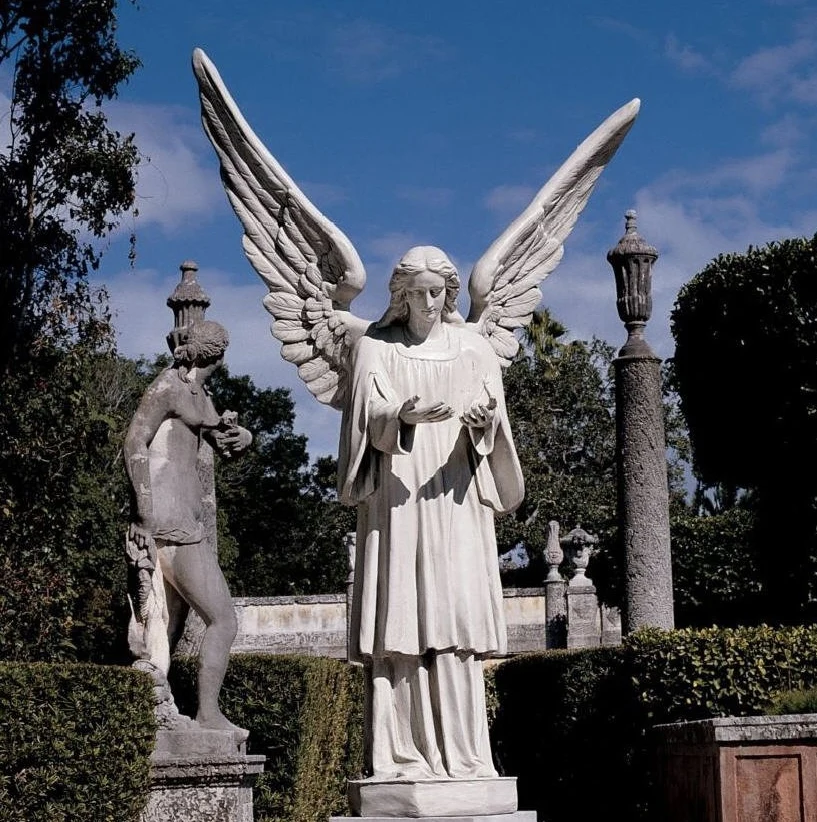
Apart from the wings, their standard form appears to mimic Earth humans (two arms, two legs, two eyes) even when they are infiltrating worlds on which the inhabitants differ from this form. Generally, their facial features are bland and serene and their proportions human-normal. However, as they close in on more aware victims they transform to a more horrific, bestial, and aspect with wide-open mouths, teeth, and hands. In the episode 'The Angels Take Manhattan', another form of Weeping Angel is shown, the. Unlike the Weeping Angels, the cherubim are not silent, making a childlike giggling and having audible footsteps.
It is not explicitly stated that these are young Weeping Angels, but they are referred to as 'the babies'. It is also implied that Weeping Angels can mimic the forms or dimensions of a broader range of statuary if required: in ' (2012), one Weeping Angel takes the form (or hijacks the existing form) of the (manifesting as a full-size Liberty with Weeping Angel features) and the final moments of ' (2007) suggest that any statue might be a disguised Weeping Angel.When they are not being observed by another being, Weeping Angels can move very quickly and silently. Their phenomenal speed allows them to close distances of meters literally in the blink of an eye.
However, when they are being observed they become 'quantum-locked', occupying a single position in space and becoming stone. In this state, they are frozen and difficult to destroy. They cannot suppress this reaction. If two Weeping Angels were to look at each other at the same time, they would be trapped in stone form until an outside force moves one out of the other's line of sight. To prevent this, they often cover their eyes while moving, which makes them look as though they are weeping. When stalking a victim, Weeping Angels will generally take advantage of their speed to avoid being trapped in the quantum lock.Weeping Angels are physically very strong, although they rarely physically kill a victim since this wastes the time-potential energy which the Weeping Angels would otherwise consume.
One exception to this behaviour is when a Weeping Angel or group of Weeping Angels wishes to communicate with other beings – in these instances, they select a victim and snap their neck prior to 'rearranging the brains' for their own purposes; the Weeping Angels are then capable of speaking and conversing via their victim's voice and senses. In the episode, ' (2010), a soldier of the Church nicknamed 'Angel Bob' suffers this fate, becoming the 'voice' of a group of Weeping Angels and explaining their motives and thoughts to the Doctor before disappearing in the rip in the fabric of time and space.Weeping Angels appear to have little culture or motivation other than those serving their basic predatory requirement of gaining energy.
The Doctor has described them as the loneliest beings in the universe since their quantum-lock reaction makes it impossible for them to socialise with other creatures. However, Weeping Angels are capable of communication, as they often work in groups and clearly communicate with each other. On those occasions when they have chosen to communicate with their prey or foes (using the gruesome proxy method mentioned above) they have demonstrated a cold and impersonal intelligence, but exhibit no empathy and no emotions beyond hunger, determination, and occasional predatory sadism. While Weeping Angels can recognise individuals in other species when the situation requires it, they themselves speak collectively and appear to have little or no concept of themselves as individuals.Weeping Angels prefer to take their energy from live victims, but if required, they can drain other forms such as that from electric lights (as seen in 'Blink') or other electronics.
In 'Blink,' the Weeping Angels attempted to steal the Doctor's after trapping him in the past. The engine of the vehicle contained enough time energy to feed them forever, but the stated that the possible damage they could cause 'could switch off the sun'. Without power, an Angel will start to decay and revert to a stone state even when not being watched. While still initially capable of movement, its speed will also be extremely hindered when close to a starvation point (as seen in 'The Time of Angels'), with its range lessened from meters to a partial step. The effects of starvation can be undone by providing the Weeping Angel with energy, but it is implied that Weeping Angels can no longer acquire energy themselves in this state.
A starving Weeping Angel becomes less and less active, and if dormant for too long will erode as a stone statue does, or even lose its physical existence altogether (although it can still exist in an image-based or conceptual state).Weeping Angels have also exhibited a startling ability to project themselves through images, suggesting that they are as much conceptual entities as physical ones. A warning in an ancient book on the Weeping Angels, found by, states that 'that which holds the image of an angel becomes itself an angel'. Using this ability, the Weeping Angels appear to be able to hijack both audio-visual equipment and organic memory.
In 'The Time of Angels', a Weeping Angel trapped in the vault of the starship Byzantium took advantage of a video screen which was playing footage of it elsewhere in the vessel: the creature escaped by overriding the screen controls and nearby electronic equipment, took over the screen, and passed through it to physically manifest in another location. Weeping Angels can also imprint a mental image of themselves into a person's mind by looking straight into their eyes: the image then gestates and takes over the person's body to manifest as a new Weeping Angel.
Was infected in such a manner where an involuntary verbal count-down indicated her remaining open-eyed moments as a human. She was able to suspend the Weeping Angel's gestation (but not eliminate it) by closing her eyes, refusing to let it breach the 'filter' of her.
In the novel Touched by an Angel, a starving angel is reduced to the point where it no longer has a physical being, and instead exists in the image viewed by cameras. As such, whatever is within the sight of the camera is within the range of the angel which retains fast movement, but at the cost of range. Normally, as in 'The Time of Angels', the Weeping Angel image would walk right out of the screen; but when it is starving, it cannot do so. To stop movement, simply viewing the screen is enough to lock the Weeping Angel.The Weeping Angels are well known to River, who appeared in two of the three major stories to date. River has mentioned that she studied the Weeping Angels and wanted to learn more about them.
In the episode, 'The Angels Take Manhattan', despite being removed from New York's history, a lone Weeping Angel gained a small victory in permanently trapping the Doctor's companions, Amy and her husband, in the past.In ', the finale for the, at least two Weeping Angels were present when the Doctor and teleported down to the planet Trenzalore. The Weeping Angels emerged from the snow-covered ground of a frozen forest during a swirling blizzard; both Clara and the Doctor were thus blinded to their presence, unable to see them as they approached.
They were, however, able to escape the angels despite this. The angels, like most of the villainous factions appearing in that episode, abandon Trenzalore when it becomes apparent that they cannot prevail against the Doctor.In the finale episode, ', a Weeping Angel is shown to be in the cloisters of.A Weeping Angel briefly appears in the Doctor Who spin-off, in the first series finale ', where the headmistress of Coal Hill Academy, Dorothea Ames, is killed by a Weeping Angel, as she was deemed to have made too many mistakes by the Governors.Appearances. One of the real-life angel statues appearing in the episode 'The Angels Take Manhattan' Doctor Who. ' (2007). ' / ' (2010). ' (2012)Cameos. ' (2011).
' (2013). ' (2015)Class. ' (2016)Details In 'Blink', a quartet of Weeping Angels send the and his companion to the year 1969, and seek to feed off the vast 'time energy' reserves of the he left behind in the present. But though they found the key to the TARDIS, they cannot find the machine itself. Sally Sparrow takes the key from one of them while it is in stone form, leading them to stalk Sally to recover it.
During their pursuit, Sally inadvertently leads them to the TARDIS. 9 June 2007. Mulkern, Patrick (23 September 2012). Retrieved 23 September 2012. Cole, Stephen (2002). BBC Books.
12 September 2007. Archived from on 1 March 2008. Retrieved 8 October 2007.
Jones, Paul (9 June 2012). Retrieved 10 June 2012. Entertainment Weekly. Retrieved 12 August 2008. Retrieved 6 August 2011. Wu, Annie (24 October 2007). Retrieved 13 March 2012.
1 February 2009. Retrieved 14 April 2012.
1 February 2009. Retrieved 14 April 2012. 9 August 2008. Retrieved 11 August 2008. Pachal, Pete. Retrieved 8 March 2017.
Molina, Brett. Retrieved 8 March 2017. Bub, Jeffrey (June 1969). 'What is a hidden variable theory of quantum phenomena?' International Journal of Theoretical Physics.
2 (2): 101–123.External links. on.
This map:.Bethesda Terrace and Fountain are two architectural features overlooking in 's. The, with its Angel of the Waters statue, is located in the center of the.Bethesda Terrace's two levels are united by two grand staircases and a lesser one that passes under Terrace Drive. They provide passage southward to the and at the center of the park.
The upper terrace flanks the 72nd Street Cross Drive and the lower terrace provides a podium for viewing the Lake. The mustard-olive colored carved stone is, with a harder stone for cappings, with granite steps and landings, and paving of laid on edge. Contents.Construction Bethesda Terrace and Fountain form the northern end of the, the only formal feature in the park's original blueprint, the.: 36–37Construction of the terrace and fountain occurred during the.
Only two major structures besides the Bethesda Terrace were completed during the Civil War: the Music Stand and the restaurant, both demolished.: 58–59 By the end of 1861, work on Bethesda Terrace was well underway.: 12–13 (PDF pp. 14–16) The stonework to be installed in the terrace arrived in 1862,: 6 (PDF p. 7) and the masonry of the fountain was installed by 1863.: 16 (PDF p.
18) In 1864, the stonework of Bethesda Terrace was completed except for minor details,: 7–8 (PDF pp. 9–10) and the Central Park commission hired a sculptor to design the figures for the Fountain.: 6 (PDF p.
7) The upper level of the Terrace was mostly built by 1867, by which time the Fountain's figures were being cast in bronze.: 8 (PDF p. 9) The Bethesda Fountain was officially completed in 1873.
Bethesda Terrace. Delta force xtreme download. The TerraceBethesda Terrace became a site for an outdoor luncheon restaurant at the end of the 1960s, then became a congregating spot for the generation before devolving into a drug-trafficking venue in the 1970s. The Terrace, designed by with sculptural decoration by, was restored in 1982, its stonework disassembled, cleaned, deteriorated surfaces removed, restored, patched, and reset. Resodding, and 50 new trees, 3,500 shrubs and 3,000 ground cover plants specified by Philip Winslow followed in 1986. However, after having matured into dense blocks, these plants were removed in 2008 to make way for plants native to the United States.The Minton of the ceiling of the arcade between the flanking stairs, designed by Mould, were removed in the 1980s renovation because the deemed the tiles too costly to restore. Instead, the Commission approved the commission of a ceiling mural in its place. Mayor declared in June 1987 that the tiles would be restored.
Nevertheless, the tiles sat in storage for more than 20 years until the Conservancy received a private donation for their restoration. The Conservancy embarked on a $7 million restoration effort to return the Minton tiles in 2004. A team of seven conservation technicians cleaned and repaired more than 14,000 original tiles by hand. Only three panels of replica tiles were needed to replace those that had been damaged beyond repair. For those recreations, the Conservancy decided to commission Maw and Company, Minton's successor in Stoke-on-Trent, England. The tiles were reinstalled in 2007.Following an illustration in an 1891 book by the Superintendent of Planting in Central Park, Vaux's assistant and partner, the lower basin once again has, and, grown in removable pots.Bethesda Fountain.
Bethesda Fountain with restored plantsBethesda Fountain is the central feature on the lower level of the terrace, constructed between 1859 and 1864, which is enclosed within two elliptical balustrades.The pool is centered by a fountain sculpture designed by in 1868 and unveiled in 1873. Stebbins was the first woman to receive a public commission for a major work of art in New York City. The bronze, eight-foot statue depicts a female winged angel touching down upon the top of the fountain, where water spouts and cascades into an upper basin and into the surrounding pool. It was the only statue in the park called for in the original design. Beneath her are four four-foot representing,. Also called the Angel of the Waters, the statue refers to, a story from the about an angel blessing the, giving it healing powers.
In Central Park the referent is the opened in 1842, providing the city for the first time with a dependable supply of pure water: thus the angel carries a in one hand, representing purity, and with the other hand she blesses the water below.The base of the fountain was designed by the architect of all the original features of Central Park, with sculptural details, as usual,. In Calvert Vaux and 's 1858, the terrace at the end of the Mall overlooking the naturalistic landscape of the Lake was simply called The Water Terrace, but after the unveiling of the angel, its name was changed to Bethesda Terrace.The panels of carving in the abstracted organic style propounded by, a mentor of the sculptor Jacob Wrey Mould are organized by an iconographical program of themes: the Seasons, the Times of Day, the Ages of Mankind. Considerable latitude was offered the carvers executing the work, following principles.By the 1970s, Bethesda Fountain was completely dry.
However, the fountain was restored in 1980-1981 by the as the first part of its plan to renovate Central Park. Kinkead, Eugene (1990). New York: Norton. Heckscher, Morrison H.
Metropolitan Museum of Art. (PDF). New York City Department of Parks and Recreation.
Retrieved January 13, 2017. The New York Times. Retrieved 2019-04-07. (PDF). New York City Department of Parks and Recreation.
Retrieved January 13, 2017. (PDF). New York City Department of Parks and Recreation.
Retrieved January 13, 2017. ^ (PDF). New York City Department of Parks and Recreation. Retrieved January 13, 2017. (PDF). New York City Department of Parks and Recreation.
Retrieved January 13, 2017. The New York Times.
Retrieved 2019-04-12. Anderson, Susan Heller (1987-05-03).
The New York Times. Retrieved 2019-04-18. January 26, 2007, at the. Clarence C. Cook, A Description of the New York Central Park, 1869, quoted in Murphy and Ottavino 1986:35. Neuffer, Elizabeth (1987-06-07).
The New York Times. Retrieved 2019-04-18. The New York Times. Retrieved 2019-04-18. Murphy and Ottavino 1986 and Champe, Peter; Rabinowitz, Mark (1999). 'Restoring the Minton Tile Ceiling, Bethesda Terrace Arcade, Central Park, New York City'. 30 (2–3): 11–16.
Described some of the difficulties surmounted in carrying out this project. Parsons, Landscape Gardening: Notes and Suggestions on Lawns and Lawn Planting.(1891), lithograph after a watercolor, page 253. The concealed wrought-iron box-girder structure of the bridge, which forms part of the park drives' essential circulation pattern, was finished early, by 1860 (Murphy and Ottavino 1986:35). ^ Murphy, Jean Parker; Ottavino, Kate Burns (1986). 'The Rehabilitation of Bethesda Terrace: The Terrace Bridge and Landscape, Central Park, New York'.
18 (3): 24–38.: 'materials science, chemical testing, historical research, and attentive site supervision contributed to the successful rehabilitation of Bethesda Terrace'. ^. The Daily Plant. XVII (3695). September 10, 2002. Retrieved January 3, 2015. Murphy and Ottavino 1986:26.
Commissioners of the Central Park Reports , noted in Murphy and Ottavino 1986:26.External links. at. My singing monsters composer pc.
at the Complete Guide to Central Park. at On The Inside.